
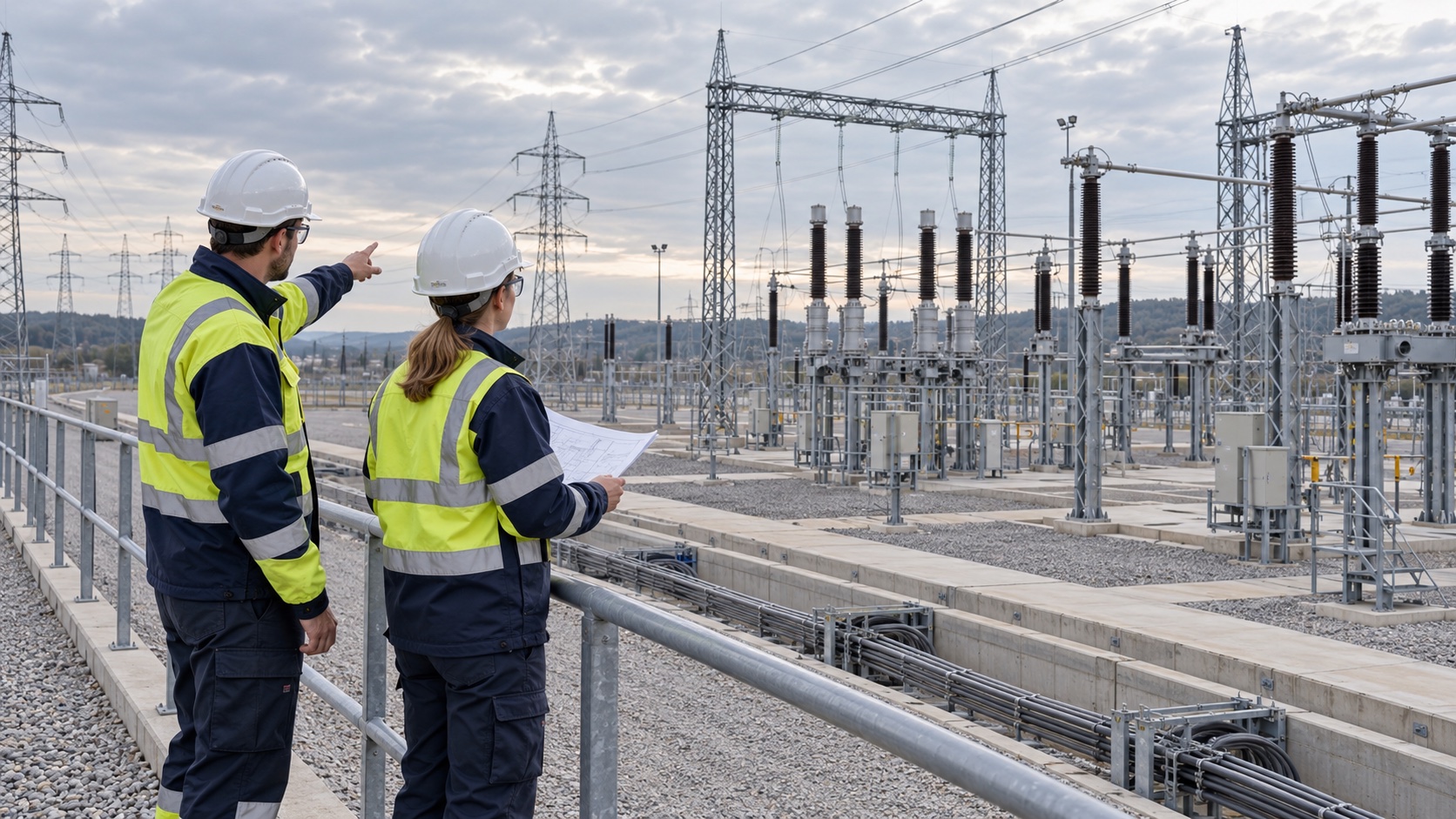
Availability is both an operating objective and, in many transmission service agreements, a payment variable. A TBCB provider therefore has to think beyond the first cost of a compliant asset: it needs equipment and a layout that can be maintained, restored and operated reliably for the contract term. The exact target, exceptions, calculation and financial effect must be read from the project's TSA.
This article develops the commercial distinction explained in TBCB in Transmission: What Changes Commercially.
Read the agreement before quoting an availability percentage
A published Indian inter-state project TSA sets a 98% target for its AC elements and project, refers to a specified regulatory method for calculating availability, and uses monthly charge bands in Schedule 4. In that example, 98% is not simply the point at which every additional hour earns an equal bonus. The payment formula has a flat band, incentive bands and reductions below the target. The TSA also contains separate DC provisions.
That document is a concrete example, not a universal promise about every TBCB project. Before modelling revenue, identify the relevant TSA version, elements, commissioning dates, outage treatment, deemed-availability rules, caps and exceptions. A network-level reliability target and a contract's payable availability can differ.
What does 98% mean in ordinary hours?
As an illustration only, 2% of a 365-day year is 175.2 hours, while 0.25% is 21.9 hours. This makes the scale of the reliability gap easy to picture. It is not a calculation of permitted outage hours or of an actual bill. Contract availability may be assessed by month and element, weighted by capacity or otherwise adjusted under the agreement and applicable regulation.
Four design questions that become commercially important
1. Can the asset be maintained without taking down more than necessary?
Bay arrangement, isolators, access, clearances and the separation of common services can determine how much equipment must be unavailable for planned work. The answer is not “always add another bay.” Test the operating sequence and outage plan for the particular substation, within the tender scope and approved reliability criteria.
2. Will a fault be detected, isolated and restored efficiently?
Protection coordination, appropriate redundancy, communication paths and event records can help confine a fault and diagnose it quickly. These choices must be justified by system studies and the utility's protection philosophy. An uncoordinated extra relay or an unsupported claim of faster clearing is not a reliability strategy.
3. Can crews repair or replace critical components?
Consider spares, lifting and vehicle access, standardised components, cable routing, safe working clearances and vendor support. A design that appears cheaper at commissioning can impose longer outages if a failed component is hard to reach or replace. Maintenance planning should be part of concept and detailed design, not an afterthought.
4. Are the bid assumptions robust enough?
The cited TSA places detailed route survey and geotechnical investigation on the provider. At bid stage, uncertain soil resistivity, ground conditions, line routing, crossing permissions and foundation quantities should be recorded as risks. Preliminary studies and sensitivity ranges can show which assumptions materially affect capital cost, completion date and later reliability. Site investigation does not remove uncertainty; it makes the remaining uncertainty visible.
Compare whole-life options, not just purchase prices
A useful option comparison has four columns: initial cost, expected maintenance cost, likely outage exposure and delivery risk. For example, a maintainable equipment arrangement might cost more at procurement but reduce planned isolation time. A cheaper route could require more difficult foundations. Quantify such differences using the project schedule, reliability model and TSA formula. Do not turn a generic “cost per outage hour” into a tariff forecast without those inputs.
The best design is the least-cost compliant and operable solution over the relevant period, after risk is accounted for. That conclusion has to be demonstrated for each project; the payment model alone cannot select the technical option.
What to put in the design review
Include the approved design basis, availability-related contract clauses, single-line and maintenance switching scenarios, protection philosophy, critical spares plan, route and soil assumptions, outage calculation method, and a short list of unresolved risks. Link each proposed design premium to the failure mode or outage duration it is meant to reduce. This gives owners and bidders a reviewable reason for spending—or saving—money.
Other markets may use similar availability incentives but different ownership and tariff structures. Transmission Procurement Models Worldwide sets out the distinctions.
Frequently asked questions
Is 98% the availability target for every Indian transmission project?
No. The cited TSA uses 98% for its AC system. Project documents and the applicable calculation method control each case, and DC assets can have different terms.
Does a higher measured availability always increase monthly payment?
No. In the cited TSA, different monthly bands have different payment effects, including a flat band and a cap. The exact formula belongs to the signed agreement.
Does more redundancy automatically improve a TBCB bid?
No. Redundancy adds cost and complexity. It should be justified by the required performance, network studies, failure modes, maintenance access and the project's commercial terms.
Explore related Elegrow services
- Engineering Design — substation and line design for maintainability.
- Power System Studies — network and protection studies.
- Substations, Lines & Grids — the wider asset context.
Review your design basis: Discuss the asset and project stage with Elegrow.