
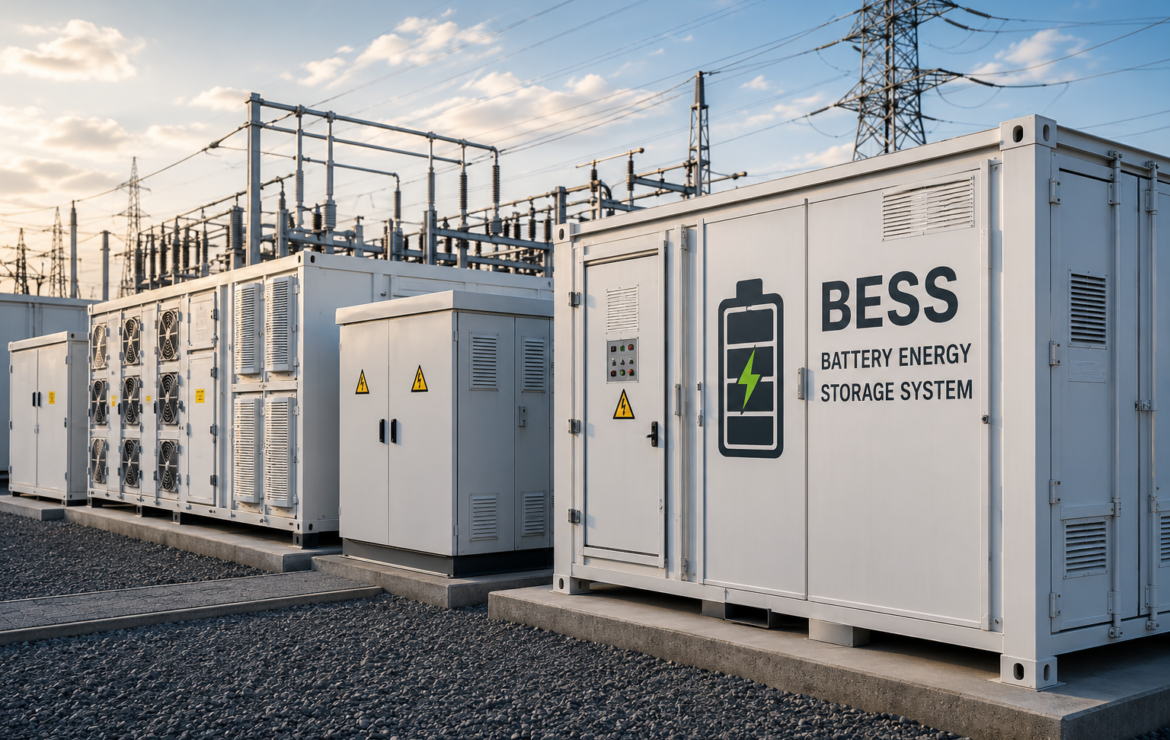
BESS Grid Connection Risk: How One Missed Study Can Turn Into a Million-Dollar Delay!!
In BESS projects, the biggest delay may not start at site.
It may start during grid connection review.
A Battery Energy Storage System may have land, permits, equipment, EPC planning, and a strong commercial model. But the grid reviewer still needs technical evidence.
The reviewer must confirm that the plant can connect safely, operate reliably, and remain compliant under actual grid conditions.
For grid-connected BESS projects, studies are not paperwork.
They are technical proof.
When this proof is missing, the cost does not stop at the study fee. It can affect COD, revenue, technical submissions, modelling work, and investor confidence.
The Cost of a Missed BESS Grid Compliance Study
Consider an illustrative 50 MW BESS project.
The project team skips one grid compliance study. The team assumes the site is similar to another project that received approval earlier.
Estimated study cost avoided: AUD 40,000
At the planning stage, this looks like cost saving.
But during connection review, the missing study becomes a technical gap. The grid reviewer asks for fresh assessment, additional simulation, revised modelling files, and resubmission.
The process takes around six months.
Now the cost changes.
Simple Delay Cost Calculation
Assume the project expects revenue of around:
AUD 200,000 per month
If grid approval delay pushes COD by six months:
Delayed revenue impact = Monthly expected revenue × Delay duration
AUD 200,000 × 6 months = AUD 1,200,000
| Item | Estimated Value |
|---|---|
| Study cost avoided | AUD 40,000 |
| Delay period | 6 months |
| Estimated monthly revenue impact | AUD 200,000/month |
| Estimated delayed revenue impact | AUD 1,200,000 |
This is a simplified example. Actual revenue impact depends on the PPA, market structure, capacity payment, ancillary service revenue, dispatch profile, project availability, and contract terms.
The study was not expensive.
The delay was.
Where BESS Grid Connection Risk Appears
| Missed Study Area | Possible Technical Gap | Possible Project Impact |
|---|---|---|
| System strength | Weak-grid or inverter instability not checked | Extra modelling, correction measures, or approval delay |
| Harmonics | THD, resonance, or background distortion not checked | Filter requirement, power quality issue, or equipment stress |
| Protection coordination | Low inverter fault current not considered | Relay setting changes, nuisance tripping, or delayed fault clearing |
| Dynamic stability | Fault response and recovery not validated | Approval delay or commissioning issue |
| Reactive power and voltage control | Voltage support capability not demonstrated | Controller change, compensation need, or compliance gap |
| EMT / PSCAD modelling | Fast inverter control interaction not assessed | OEM model validation and extended review cycle |
One missed study does not remain only an engineering issue.
It can affect approval, schedule, revenue, and stakeholder confidence.
Why “Similar Site” Is Not a Safe Assumption
Project teams often assume that a nearby or similar site will behave the same way.
That assumption can create risk.
Two BESS projects may have the same capacity. But their electrical behaviour can still differ.
The difference may come from:
- Short circuit level at the connection point
- X/R ratio
- Transformer impedance
- Feeder length
- Nearby solar, wind, or BESS plants
- Background harmonics
- Protection philosophy
- Grid operating scenarios
- Plant controller settings
- Utility requirements at the time of submission
In power system studies, location similarity does not mean electrical similarity.
A 50 MW BESS may work well at one connection point.
The same 50 MW BESS may need extra modelling or correction measures at another point.
Why System Strength Matters for BESS Projects
System strength matters because inverter-based resources depend on the grid voltage waveform.
In a strong grid, the voltage waveform remains more stable during disturbances.
In a weak grid, inverter controls can become more sensitive to faults, switching events, voltage changes, and nearby renewable generation.
A system strength or weak-grid assessment helps identify risks such as:
- Poor voltage waveform stability
- Inverter control instability
- Oscillations between nearby inverter-based resources
- Low fault level for protection operation
- Poor post-fault voltage recovery
- Ride-through performance issues
- Need for control tuning or EMT modelling
If the grid has low system strength, the project may need grid-forming inverter functionality, synchronous condenser support, STATCOM support, revised control settings, or additional RMS/EMT studies.
Each of these items can affect project cost, timeline, and approval.
How a Missing Grid Study Delays Approval
One missing grid study rarely creates only one issue.
It usually starts a chain reaction.
1. The reviewer finds a technical gap
The submission does not prove compliance for a required condition.
2. The reviewer asks for more data
The project team may need updated models, inverter data, controller details, or revised study scope.
3. The team needs OEM or consultant input
Many BESS studies need OEM-specific inverter models, plant controller data, or validated simulation files.
4. The team performs or revises the study
This may include RMS simulations, EMT/PSCAD studies, harmonic modelling, protection review, or updated fault level cases.
5. The findings may trigger changes
The study may lead to setting changes, equipment changes, control changes, or correction measures.
6. The team resubmits the package
The revised package enters another review cycle.
This is how one missed study can become a multi-month delay.
BESS Grid Connection Checklist: Key Studies to Review
The exact requirement depends on grid code, project size, voltage level, location, network strength, and utility requirements.
Still, BESS teams should review these studies before submission.
1. Load Flow Study
This checks voltage profile, active and reactive power flow, transformer loading, cable loading, and equipment loading.
For BESS projects, the study must review both charging and discharging modes.
If the team skips this review, the project may face voltage issues, equipment overload, incorrect transformer sizing, or operating limits.
2. Short Circuit Study
This calculates fault levels at buses and connection points.
For BESS projects, the team must consider inverter fault contribution. Inverters limit and control fault current. They do not behave like synchronous generators.
If the team misses this study, protection may fail to detect faults correctly. The team may also select incorrectly rated equipment.
3. Protection Coordination Study
This confirms that relays and breakers isolate faults correctly.
For BESS projects, the study must consider inverter fault current limits, anti-islanding protection, transformer protection, feeder protection, and utility coordination.
If the team misses this review, the plant may face nuisance tripping, delayed fault clearing, or unsafe fault response.
4. Harmonic Study
This checks voltage and current distortion from inverter-based equipment.
BESS converters can interact with network impedance. This can create resonance or power quality issues.
If the team skips this study, the project may face overheating, equipment stress, power quality issues, or late filter addition.
5. Dynamic Stability Study
This checks how the plant behaves during grid events.
It reviews fault response, voltage recovery, frequency response, reactive power response, active power recovery, plant controller behaviour, and interaction with nearby generation.
A project can pass steady-state checks and still fail dynamic performance requirements.
6. Fault Ride-Through Assessment
This checks whether the BESS remains connected during voltage dips, voltage swells, and grid faults.
It typically reviews LVRT, HVRT, reactive current injection, active power recovery, post-fault stability, and inverter trip settings.
If the team misses this assessment, the project may fail during compliance testing or grid performance validation.
7. Reactive Power and Voltage Control Assessment
This checks whether the BESS can support grid voltage at the point of connection.
The review should include power factor range, reactive power capability, voltage droop control, plant controller response, and capability at different active power levels.
If the plant cannot meet voltage control requirements, the team may need controller changes or extra reactive compensation.
8. System Strength Assessment
This checks whether the grid can support stable operation of inverter-based resources.
The study may include short circuit ratio review, available fault level assessment, weak-grid operation check, inverter interaction review, and control stability review.
If the team misses this assessment, the project may face late modelling requests, correction requirements, or approval delays.
9. EMT or PSCAD Modelling
In weak grids or high inverter-penetration areas, RMS studies may not be enough.
The team may need EMT or PSCAD modelling to study fast inverter control interactions.
If the team discovers this requirement late, the project can lose time. OEM model availability and validation often take coordination.
10. Grid Code Compliance Matrix
A grid code compliance matrix connects each requirement with supporting evidence.
It should include the grid code clause, study reference, model reference, equipment capability, compliance status, open issues, owner, and submission readiness.
Many delays happen because studies, drawings, models, and equipment data do not match.
Technical Questions Before Submission
Before submitting a BESS grid connection package, developers and EPC teams should ask:
- Have we identified all required studies for the project location, voltage level, and capacity?
- Have we modelled both charging and discharging modes?
- Are inverter models validated and suitable for the study?
- Have we finalized transformer impedance, tap settings, and earthing configuration?
- Have we checked minimum and maximum fault levels?
- Have we checked protection sensitivity under low fault current conditions?
- Have we considered background harmonics and resonance risk?
- Have we demonstrated reactive power capability at the point of connection?
- Have we verified LVRT and HVRT requirements?
- Does the project need a system strength assessment?
- Does the project need RMS or EMT studies?
- Do equipment datasheets, SLDs, models, and reports match?
- Do we have enough time for authority comments and resubmission?
These are not only technical questions.
They are project risk questions.
When Should BESS Grid Studies Be Reviewed?
Project teams should not leave grid studies for the final submission stage.
They should review them in stages.
Feasibility stage
Identify connection point risks, study requirements, fault level concerns, weak-grid indicators, and possible showstoppers.
Design stage
Perform detailed studies using selected inverter data, transformer details, collector system design, plant controller philosophy, and finalized SLDs.
Pre-submission stage
Check consistency between studies, models, reports, drawings, equipment data, and the compliance matrix.
Pre-commissioning stage
Validate protection settings, controller response, equipment configuration, communication readiness, and compliance test requirements.
This staged approach helps reduce last-minute surprises.
How Elegrow Technology Supports BESS and Grid-Connected Projects
Elegrow Technology supports renewable energy, BESS, industrial, and utility projects with power system studies, grid compliance review, technical audits, design review, and pre-commissioning validation.
Our support includes load flow study, short circuit study, protection coordination study, harmonic study, dynamic stability review, arc flash study, earthing and lightning protection study, grid compliance review, design review, technical audits, owner’s engineering support, and pre-commissioning validation support.
Our focus is to help project teams identify technical risks early.
This helps reduce approval delays, performance issues, and commercial losses.
Review Your BESS Grid Study Package Before Submission
A missing study is easier to address before submission than during grid connection review.
If you are planning a BESS, renewable energy, or industrial power project, Elegrow Technology can help review your power system study requirements, grid compliance gaps, and technical risks before they affect approval timelines.
Connect with Elegrow Technology for a technical review:
Reach out to us ar info@elegrow.com or Call – +91 8128279173
Final Thought
In BESS projects, compliance should never be a final-stage formality.
Once a project reaches grid review, missing evidence can become a schedule risk.
Review the required grid studies early.
Because the grid does not approve assumptions.
It approves evidence.
Disclaimer: This article is for educational and awareness purposes. The scenario used above is illustrative/composite and does not refer to any named project or organization. Project-specific requirements may vary depending on location, grid conditions, project capacity, applicable regulations, utility requirements, and applicable grid codes.